
Trust, Gardens, and the Tools We Build
It's 2026 and questions of trust and sovereignty around our digital technologies are on all our minds. We’ve chosen to think through these questions through writing and experimentation.
What would it take to build trust back into the systems we all depend on? This question led us to publish a series of posts on Dripline. Together they circle around a simple question: how can we trust online information? These pieces formed the following arc: definitions of terms, provenance, AI, identity, discourse, and finally tools.
It began with definitions. Cole wrote a Digital Trust Glossary. It pins down the terms that we found slippery in conversations: integrity, authenticity, privacy, provenance. This glossary laid the foundations for the posts that follow.
Udit picked up the thread and asked Who took this photo?, tracing how provenance works in practice: from Ottoman calligraphic seals to the C2PA standard being field-tested by Reuters photojournalists in Ukraine. If you’re interested in learning about provenance, this piece introduces the technologies that can prove where a piece of media came from.
Then, Cole went deeper with Similarity at Scale by exploring perceptual hashing. These are the algorithms behind Shazam and reverse image search. It enables systems to recognize the same media even after it's been compressed, cropped, or re-encoded. If cryptographic hashes are data’s fingerprints, perceptual hashes are fingerprints for what media looks and sounds like. Perceptual hashing is an excellent way to track content across the messy, mutating web.
Andi's The Other AI maps out what artificial intelligence could look like if cooperatives built it instead of corporations. Data co-ops pooling member data on their own terms. Community-owned compute that stays local. A "solidarity stack" where open-weight models, cooperative governance, and shared infrastructure replace the extractive defaults. Hypha's own RooLLM project is an early step in this direction.
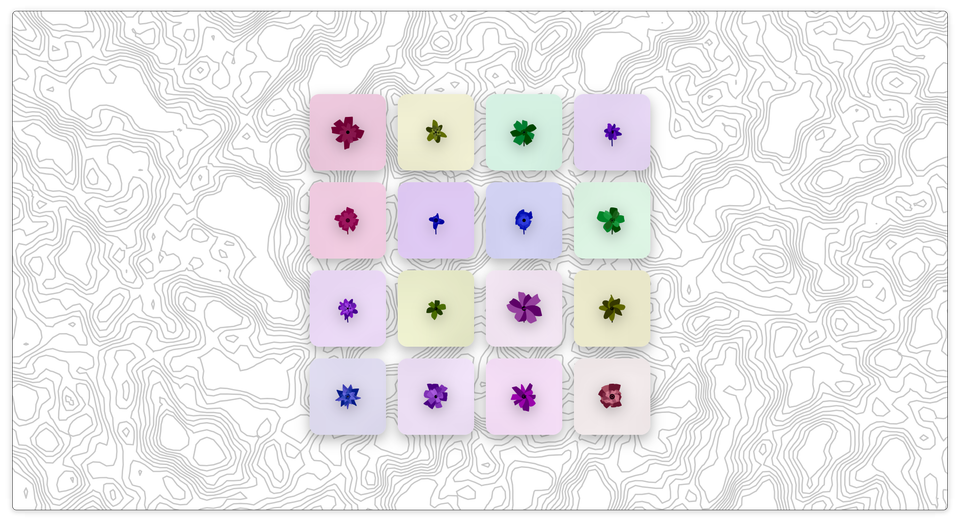
We’ve also been experimenting with affordances of Atproto, the protocol that underlies the Bluesky social network. Lexa explained why We built you a garden where everyone gets a unique flower and a garden space of their own. All visitors get a colour palette generated from their decentralized identity. In this garden, no algorithm decides what you see, you collect other people's flowers, and follow trails of spores through a web of interconnection. It is meant to be playful, human, and fun to explore. It captures the spirit of the early internet while leaning on modern open web protocols.
Violet traveled back in time three hundred years to find inspiration for the present. In Fixing bad opinions, theories of public discourse are mapped onto Discord servers and Bluesky feeds. The piece also presents The New Intelligencer — a tool that reads your entire Bluesky feed and produces a daily newspaper, turning the firehose into something you can actually think with.
Finally, we introduced Rook: Sovereign Intelligence for the Solidarity Economy and Beyond, a privacy-preserving AI knowledge agent that runs on your organization’s own data.
Beyond our screens, some of us will be out in the world: next week, Andi and Vincent are heading to Canada’s National Summit for AI and Culture in Banff, and Cole and Udit will be presenting at the ATmosphere Conference in Vancouver at the end of March. If you're at either, come say hello.
One idea keeps surfacing through all this writing: the tools we use shape the conversations we have, and those conversations shape the world we build. We'd rather build with care.
Happy Spring!
May you find beautiful flowers in your garden.